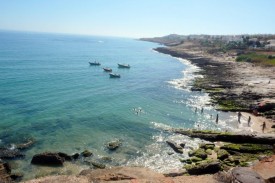
Praia da Luz, or Luz, is a village and resort located approximately 6 kms west of Lagos on Algarve, Portugal. Now officially called Vila da Luz, Praia da Luz means 'Beach of the Light'. It originated as a small fishing village however the industry is now dwindling and is only found in isolated areas towards the west. Over recent years it has been transformed by several apartment and villa complexes into a holiday location.
Historians have proved that settlements have existed in Luz for millennia and it has been inhabited by many cultures.
The Romans left behind the remnants of a spa, which represents one of the more important archaeological discoveries and an aquaduct. After the decline of the Romans the Algarve began to be threatened by the Moors who transformed the area into a major economic power however they were expelled from the Algarve after the Christian conquest.
In the Middle Ages Luz was officially referred to as Nossa Senhora da Luz – ‘Our Lady of Light – the name of the village Church.
At the start of the 1500’s Lagos was recognised for its importance regarding the abundance of fish. Three factories eventually developed in the area, the most recent in 1884. It served to conserve fish in olive oil prior to the salting of sardines. These factories supported around 100 workers, with the majority of them being women. Much later a further factory was built in Espiche however only the ruins remain today. Luz was also a major producer of figs which were regularly exported for use in the making of fine sweets. Barley and wheat were also grown in many of the local areas.
 Like many of the coastal areas of Portugal, Luz was suseptible to attacks by pirates from North Africa. Luz was frequently attacked by the Moors. They sailed the water of the Algarve, attacked small settlements, and stole treasures from the churches and homes. Vicente Benevides, the local Priest, realised that the original image of Nossa Senhora da Luz was taken by the Moors in one such raid. The Forces loyal to the King found the image and the King returned it to Luz. He ordered the building of a fortress to safeguard the image and protect the community. Within the confines of the fortress a tower was constructed in 1624 and walls were then added to circle the fortress.
The use of the name Praia da Luz is actually fairly recent. It was first introduced by sunbathers in around 1928 and its use increased rapidly in the second half of the 20th century along with the influx of tourists. Today there still remains a distinction between the modern civil parish of Luz and the medieval centre which is the historical village.
Luz is located in the southwest corner of the municipality of Lagos. It covers an area of approx 21.78 km². It is bordered to the south by the Atlantic Ocean. The parish includes three settlements (Luz, Almadena and Espiche) and is marked by two mountainous areas - Montinhos da Luz (99 metres) and Montinhos do Burgau (68 metres). Four ravines flow from north to the south: Ribeira do Vale de Barão, Ribeira de Almadena, Ribeira de Espiche and Ribeira da Luz.
The blue flag beach in Praia da Luz is of intermediate size and features two distinct zones - the white sand beach and the rocky cliff, both characteristics of the Algarve. The waters are typically clean and transparent but the temperatures are variable due to the influence of the Atlantic currents.
 The older parish of Luz was a small centre however by the 18th century, following the Lisbon earthquake in 1755, the region was destroyed and many residents abandoned the area. The redevelopment only began in the second half of the 19th century. In 1893 the census showed a population of less than 1712 inhabitants.
Luz is dominated by its beach which extends as far as the cliffs on the south coast and is part of the Algarvian Gold Coast. During the Age of Discovery fishing was the catalyst that developed the settlements of Luz during the 13th and 14th centuries and this progressed to whaling by the 16th century. Fishing, including octopus potting, was the main occupation in Praia da Luz until the 1980s when it was surpassed by tourism and the old fishing village was enveloped by small holiday resorts. Along the beach many of the canning plants which closed were replaced by water sports and activity centres. A nightclub, restaurants, cafes, bar and shops tailoring to the seasonal visitor are now a major part of Luz. Also a lot of the agricultural fields were purchased by developers for the building of holiday accommodation and properties for the many ex-pats.